Health program improving lives in Bangladesh
The Health Leader program in Bangladesh is providing life-saving health education to women and their families in rural parts of the country where access to healthcare is limited. Many women are benefiting from receiving basic knowledge about sanitation, women’s health, menstruation, pregnancy and childbirth. Here are some of the stories of the women in Bangladesh whose lives are being transformed thanks to participation in the Health Leader program.
Ansara
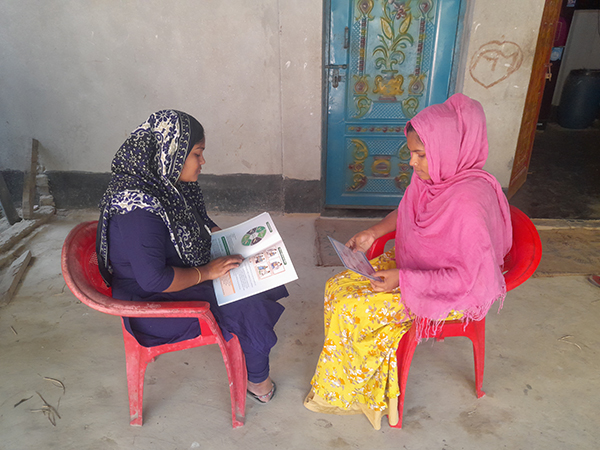
Health Leader Bithy (left) educating young mother Ansara about pregnancy and infant care.
Ansara is a young married mother who left school early but craved learning. When she became pregnant, Ansara wanted to learn about how to take care of herself during pregnancy and the birth, as she had seen many of her friends suffer complications and one of her friends had sadly passed away in childbirth.
Ansara began seeing a Health Leader named Bithy, who taught her about the importance of nutrition and sleep during her pregnancy, and helped her find a hospital to give birth in. Her husband’s parents were against Ansara seeing a doctor and getting care whilst pregnant as many elders had the false suspicion that every birth attended by a doctor would be a caesarean section. Ansara, with the support of Bithy, managed to convince her husband and in-laws that she needed a birth plan and support. Her husband took her to appointments, and they chose a hospital that had a doctor on call.
Ansara gave birth to a healthy baby girl in February, and is exclusively breastfeeding and looking after her baby well. She went against the advice of elders who in the past have given sugar water and honey to infants.
“I was a shy girl who used to know little about married life, reproductive health, pregnancy and newborn care, but basic health education training has taught me a lot and now I have confidence regarding health issues,” said Ansara.
“I also inform my family and extended family members about different health topics I learned from the trainings. This information is helping us to clarify a lot of misconceptions. The village is benefiting a lot as they are getting necessary health information and transforming their lives with it.”
Bilkij
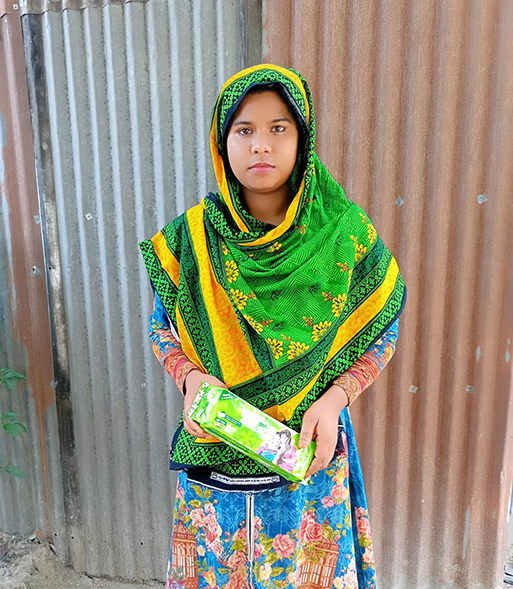
Bilkij received education from her Health Leader about puberty and menstruation.
Bilkij is a 17-year-old girl who had not been educated about puberty, menstruation and her changing body. When she got her first period she was scared and didn’t tell anyone. Each month she would stay home from school as she didn’t know how to deal with it. She began to fall behind academically and struggled to keep up with her classmates as she missed so many days of school. Fortunately, she met local Health Leader Fahmida who visited her home and started educating Bilkij about puberty. Fahmida made weekly visits and used flash cards and books to tell her about how to manage her menstrual cycle. She gave her sanitary pads to use and Bilkij now keeps some spare in her bag in case she gets her period.
Bilkij is now armed and ready with this basic health knowledge and doesn’t have to feel ashamed or embarrassed about the changes she is going through, and can attend school without fear.
Mariam
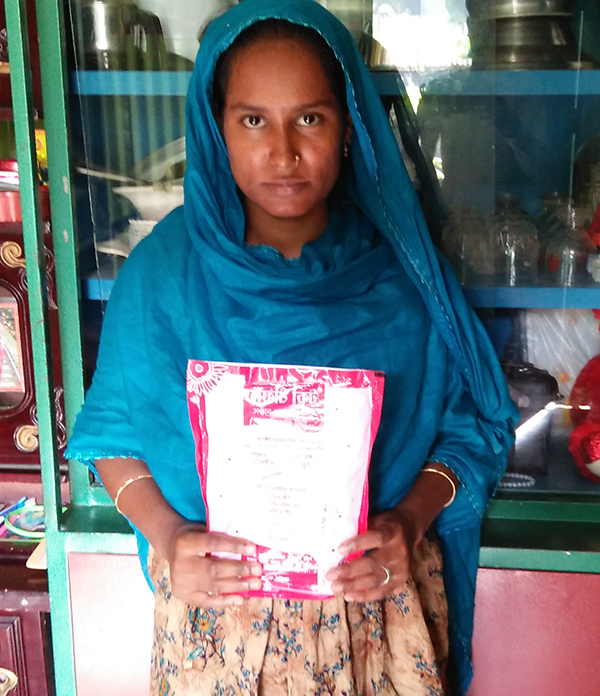
Mariam holding her birth safety kit she received from her local Health Leader.
Mariam is a young mother who struggled with her health in her first pregnancy and childbirth due to lack of knowledge about basic healthcare during that time of her life. She suffered from anaemia and malnutrition, she had no access to a mid-wife or doctor during the birth and her baby had a low birth weight and was unwell. She didn’t seek medical advice as she believed the many superstitions about doctors she had been told.
Mariam was fearful of having another baby, but after seven years, a local Health Leader called Hamida began basic education about pregnancy and childbirth in her community. Mariam learnt how to take care of herself during pregnancy, with good nutrition and rest, and was told that having regular antenatal check-ups with nurses and doctors was the best way to prevent complications.
With this knowledge, Mariam became more confident, and she is now pregnant with her second child. She has received a birth safety kit, has regular check-ups and has booked the hospital for the impending birth.
“If someone had given me advice like this before, I probably wouldn’t have had to suffer so much with my first child,” said Mariam.
Sultana
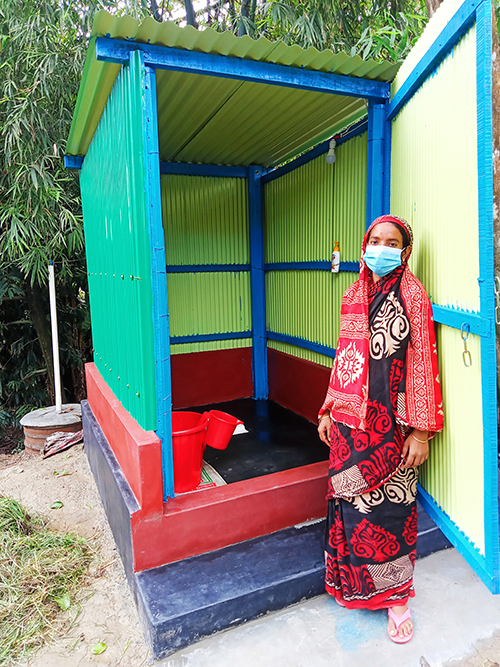
Sultana and her newly-built toilet in her backyard.
Sultana is a small business owner, who had taken out a small loan with local microfinance institution BURO in Bangladesh. BURO approached Sultana and asked her to be part of the Health Leader program, and she happily said yes.
As part of her training to become a Health Leader, Sultana learnt for herself a lot of basic sanitation, hygiene, and healthcare information. She realised that in her own family a lot of improvements were needed.
In her family home, they did not have a toilet, so they were using holes dug in the side of the pond next to the house, fenced with old cloth. They did not have the facilities for decent handwashing either. During monsoon season the pond would be flooded and sewage would be spread across the whole area. The family would often get sick with diarrhoea and didn’t have the knowledge to connect it to the unhygienic toilets.
Sultana and her husband used some of their savings to build a new hygienic toilet block in their backyard. They now have the facility to wash their hands and they aren’t getting sick anymore.
Sultana has been able to teach others the same lessons about hygiene and sanitation and has gained respect and acceptance as a leader in her community.
Project supported by the Australian Government through the Australian NGO Cooperation Program (ANCP).